• Skip to main content
  • Skip to footer

Lightbulb Trust

Changing lives for the better

  • About
  • Charity Partners
  • Social Investments
  • Impact & Research
  • Greenlight Project
  • Blog

Luisa Gockel

Looking back at 2023 and ahead to 2024…

18 January, 2024 by Luisa Gockel

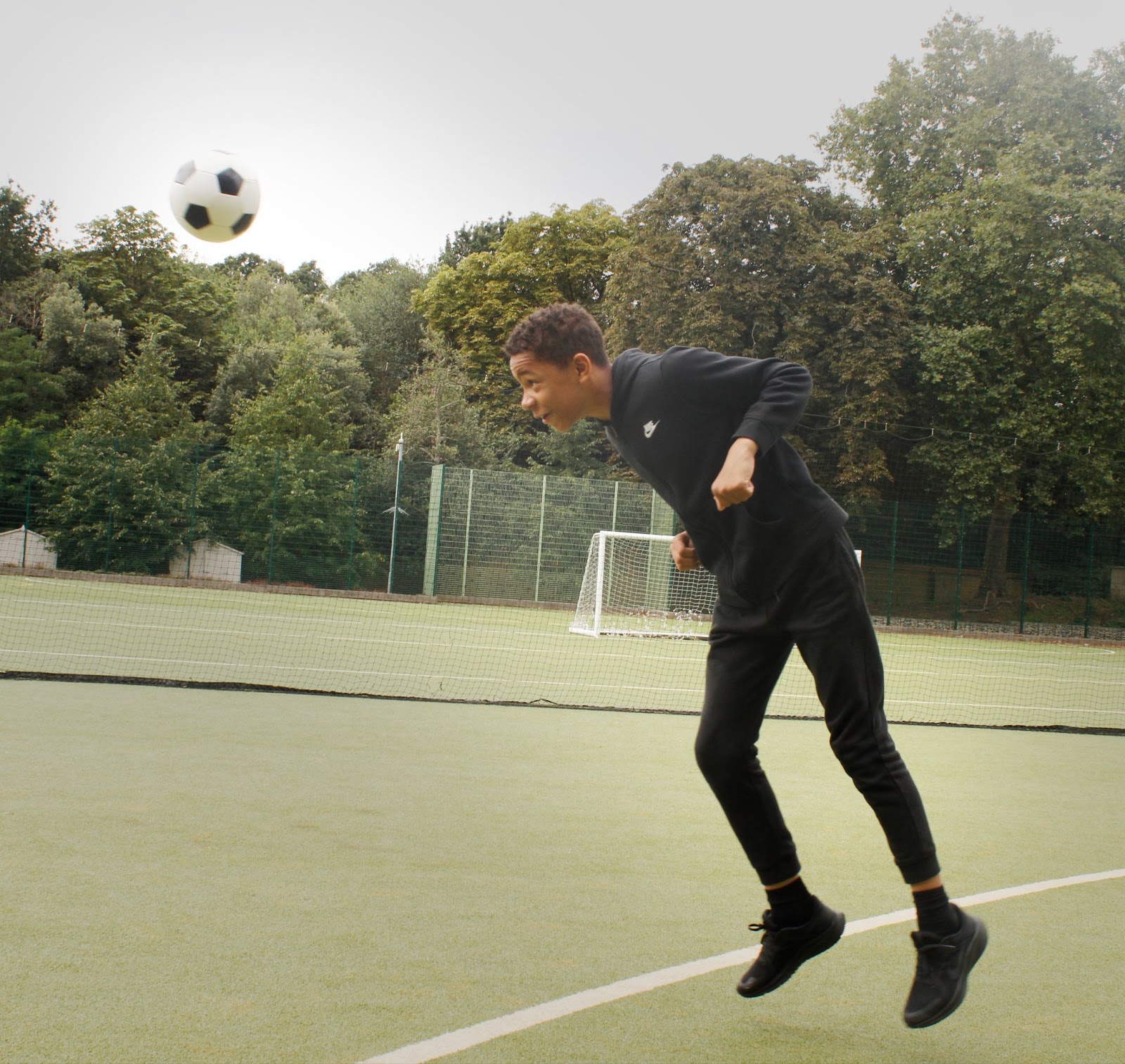
The photographs on the easels are striking: a girl reaches beguilingly out to the lens, pulling you in with her vivacious eyes as much as her hand; a young woman salutes the camera and stares pointedly sideways, military cap atop headscarf; a lad is suspended in mid-air, as he heads a ball hanging like a full moon; another boy perches on a wall in his shades, striking a cheeky Mod pose. 

These fantastic images adorned the Lightbulb annual breakfast during late November 2023. They brightened the room, just as our partners consistently brighten lives. More than thirty of these organisations’ leaders gathered at Megan’s in the High Street, in the heart of the borough of Kensington and Chelsea, the community that we serve with so much of our work. We all came together to share ideas, celebrate our common purpose, and break banana bread (any surplus food was delivered immediately afterwards to the food bank at Refettorio Felix in Earl’s Court).

The fine art portraits could have been taken by Misan Harriman but were in fact the work of West London kids, their subjects being their friends – all under the expert guidance of another famed photographer, Alison Jackson. These workshops, facilitated by Lightbulb’s support and in partnership with Young K&C, took place during the summer at Caxton Youth and Solidarity Sports (as they had previously at other Lightbulb partners, Design Museum, Earls Court Youth Club and Dalgarno Trust, among others). 

The portraiture captures brilliantly the incredible spark, bright exuberance, and sheer potential of these young people: kids – like countless others – who benefit regularly from the amazing programmes laid on by our wonderful partners (offerings such as Alison’s specialist workshops, which will culminate in an exhibition later this month at Cadogan Hall, no less). 

We are proud to have helped this past year so many brilliant practitioners provide people – young and old – with such opportunities to forge ahead, be it via safe and inspiring places to be, expert mentor support, or other means… all leading toward enhanced chances for these individuals to shine (excuse the obligatory Lightbulb pun).

Since our previous annual breakfast event in 2022 (yes, as you ask, it has become our favourite morning of the year), Lightbulb awarded thirteen grants from our Greenlight fund to the tune of £400,000 and twenty-one grants from Lightbulb totalling £585,000. 

We also, during 2023, made two impact investments to inspirational start-ups. Social enterprise investment has always been a driving element of Lightbulb, from the get-go, but often had to come second to grant-making. This is changing. Our investment arm has expanded, thanks to the expert help of new senior adviser Colman Chamberlain during the latter half of 2023. Having refined our processes with Colman, we want to be as transparent about them as possible. To that end, we recently laid out our investment strategy on the Lightbulb website.

We have of course greatly missed our brilliant Director, Luísa Gockel, the glowing filament of Lightbulb, during those recent months (though, as with everything we do, she too was behind this recent impact investment drive) – but rejoice also that Luísa welcomed her third child, Tiago, into the world! While Sonia Bouclainville has deputised superbly in Luísa’s absence, with Colman’s input, we of course look forward to welcoming Luísa back from maternity leave in due course later this year.

Other highlights of 2023 included our ramped-up pro bono offerings. We will always look for new ways to buttress the services and offerings we can provide our partners, to aid growth and enhance capacity. Our friends at Analysis Group continued to make huge differences to the processes of several key partners, remarkable organisations such as West London Zone, Football Beyond Borders, and The Shannon Trust (please check out the blog on the latter collab here).

Meanwhile, impact consultant Jami Dixon offered insightful support to multiple other partners via a range of webinars, drop-in calls, and also more tailored exchanges. Read more here about Jami’s transformative work with us and what is coming up from her (including in the next few weeks).

We remain incredibly grateful to Analysis Group and Jami for their fantastic support, as we do our trustees.

Lightbulb also enjoyed fostering further excellent collaborations between partners via our Integration Challenge. These team-ups remain consistently rewarding success stories, proving that two plus two sometimes really can equal five (and then some)! They included, toward the end of 2022, under the Greenlight umbrella, The Curious School of Puppetry working with Steppaz arts and dance school; and then, in West London on the Lightbulb side, Nova and Earls Court Youth Club both teaming up with West London Zone (read more about the former partnership here).

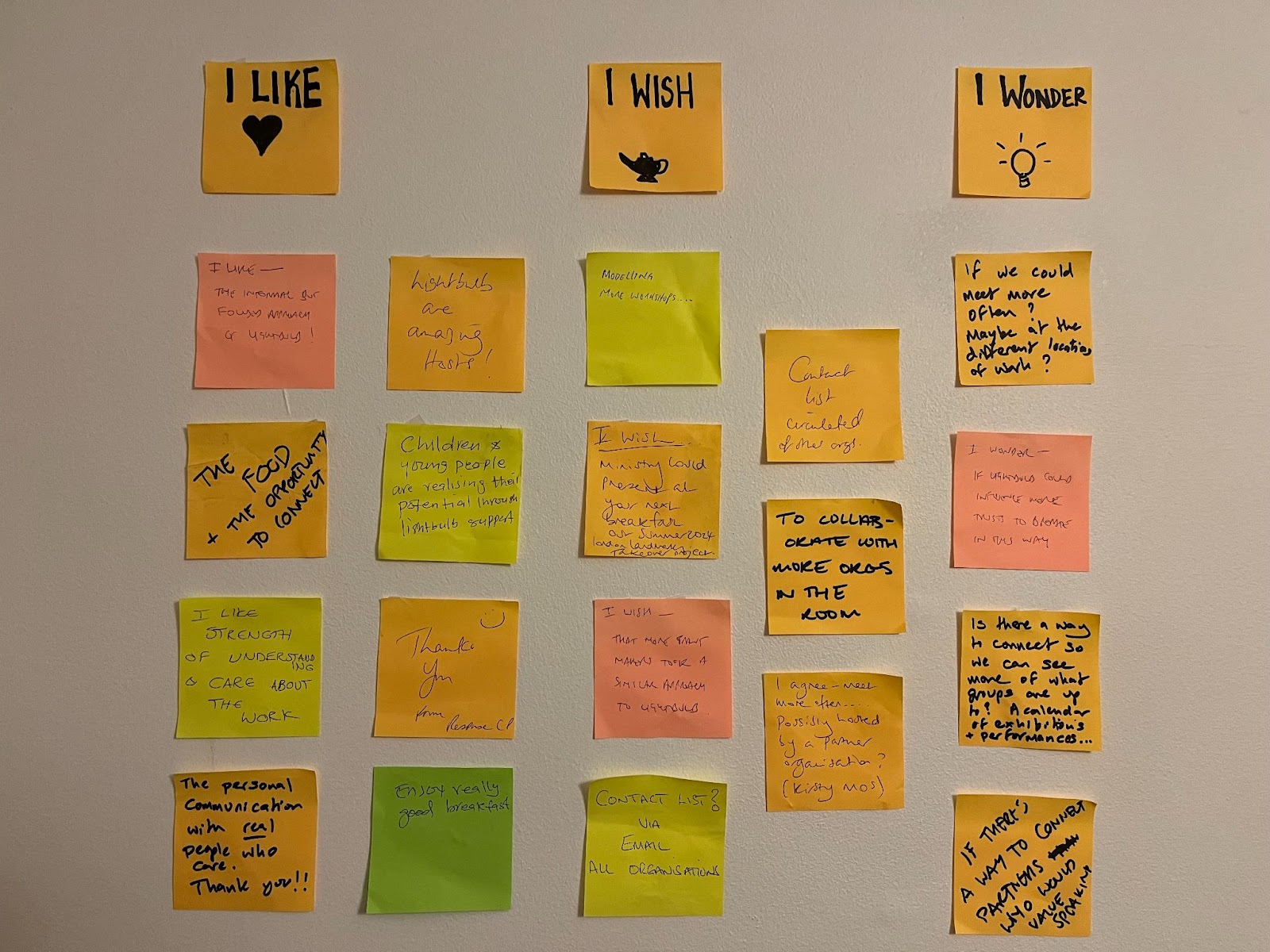
Lightbulb, in these sorts of ways, remains committed to supporting the network of brilliant charities with whom we partner with more than just grants. We want to prove more than the sum of our parts, to help change lives for the better. We are committed to adopting innovative methods wherever possible and continually hone our processes to make our funding as intentional, user-friendly, and meaningful as possible: for example, this past year, in consultation with partners and in accordance with our own theory of change, we recalibrated our application process. We owe it to those partners to remain nimble, self-critical, and open. Indeed, at the Breakfast event, we asked attendees to share insights and feedback beneath three blue-skies of Post-Its… ‘I wish’, ‘I wonder’ and ‘I hope’ (the responses were suitably thought-provoking). 
The fundraising landscape for charities remains as tough as ever. We have moved through Covid but its aftershocks rumble on, particularly in mental health. The cost of living keeps stinging. Political change and renewal may be in the air – this year, over four billion people will vote in elections worldwide, more than ever before – yet we all know that these touchstone challenges aren’t going away anytime soon. 

We will never rest on our laurels. During the past four years, we have paid out more than £2.3 million. Yet we try to help not just financially, as explained already. We want to be as mindful and proactive funders as possible simply so that our partners are enabled to do their best work. We are resolved to continue that mission this year (our fifth). With those inspiring photographs taken by young people of young people firmly in mind – photographers and subjects who all deserve the very best possible chances in life – we feel more determined than ever to keep trying our best. 

Salome & Ben Holden

Trustees & Co-founders, The Lightbulb Trust

Filed Under: Uncategorized

The Lightbulb Trust’s Impact Journey: It all started with a theory of change

29 November, 2023 by Luisa Gockel

In early 2022, I teamed up with the Lightbulb Trust to create their theory of change (if you’re not sure what this means then check out this short video). This essential groundwork aimed to crystallise the organisation’s core mission and impact objectives.

After a few discussions about the problem the Lightbulb Trust aims to solve, their overarching vision and impact ambitions, we crafted an initial draft. Thanks to Supafrank who brilliantly transformed our theory of change concept into a visually engaging design, you can check it out here.

Underpinning our theory of change is a key understanding: while many societal challenges are multifaceted, the Lightbulb Trust’s primary focus centres on expanding access to diverse learning opportunities and support systems. Unequal access to education leads to an achievement gap and reinforcing social, economic and health inequalities. The Lightbulb Trust wants to see more opportunities for everyone to learn and reach their potential. 

Following the theory of change, we explored how it could guide the organisation, support decision-making and assist partners with grant reporting.

Our work has since expanded to support our partners in improving their impact practices. This included:

  • Informative Webinars: We’ve hosted webinars on important impact topics, including the Impact Cycle, theory of change and data collection approaches and tools. The webinars are all designed to create opportunities for partners to share experiences and learn from each other.
  • Drop in calls: Partners have been offered the opportunity for a 30 min call to discuss a specific issue or challenge they’re facing.
  • Tailored support: We offered one-on-one support for partners who need some in-depth technical assistance to help them develop their organisation’s impact practice. They had 1 day of support that they could use flexibly across a 3 month period. The support has looked different for each organisation, depending on where they’re at. For some it involved creating individual theories of change, and streamlining data collection, and for others it focussed more on analysing data and how to use it to demonstrate impact and support decision-making.

What’s next?

Last year we received feedback from organisations suggesting that standard impact measurement approaches don’t work for them, especially smaller, community-based groups. It’s commonly grass-roots organisations that are dealing with complex and evolving needs and offering a diverse range of coexisting services to respond to this. As a result of this feedback, together we are launching a “creative methods pilot” programme in January, with a small cohort of organisations. I love using creative tools as a way to engage people in evaluation activities and am really excited to see what partners want to try out and what we learn. Not only can creative methods be a lot of fun, but they’re a great way to engage different groups of people, deal with sensitive topics and also help to shift some of the power dynamics.

Working with the Lightbulb Trust and their partners has been a pleasure. As a funder they put a lot of emphasis on consulting with partners about what support they need, making sure resources are used wisely and adapting based on feedback. 

The partner organisations I’ve worked with are pragmatic, creative problem-solvers who meet people where they are. They’re passionate about creating opportunities and meaningful change in their communities.

Together, we’re committed to improving education and learning opportunities, refining support to partners, and embracing creative methods to leave a lasting impact.

Jami Dixon, Impact and Evaluation Consultant

Filed Under: Uncategorized

WLZ and Nova: the power of collaboration

9 June, 2023 by Luisa Gockel

In November 2022, the Lightbulb Trust Integration Challenge initiative saw West London Zone (WLZ) and Nova New Opportunities (Nova) come together to deliver joint careers workshops to children and young people in two West London Zone schools.

The aim behind Nova’s Living Career Library programme was for a range of career professionals, called ‘Living Subjects’, to speak to groups of young people about various careers; facilitating open and honest conversations with them about the pathway into different careers, what skills they might require, and what the progression opportunities are.

Through partnering with West London Zone, Nova was able to deliver the programme to a target group of 28 young people on the WLZ programme. Link Workers, who act as the trusted adults and mentors for WLZ, selected a group of children from Capital City Academy and Westminster Academy, who they believed would benefit most from this project.

The Link Workers would serve as a consistent presence to ensure the young people remained engaged throughout each session. In these ways, they facilitated conversations between the Nova Living Subjects and the young people attending, allowing for positive and informed discussions to ensue.

Exploring new career paths

In conducting the pilot project, a key objective was for students to learn more about different careers that they may not have known existed but that reflect their interests and skills. WLZ were thrilled with the opportunity to expose young people on their programme to exciting career trajectories that aren’t often at the forefront of the average teenager’s radar, but that could in fact lead to fulfilling work lives.

Speed networking

In each workshop the Living Subjects – expert professionals – were separated among tables of 3-5 young people. Each table then had 10-15 minutes for the children to ask questions about the adults’ careers and explore how each one might fit with their own interests/skills/strengths. The Living Subjects then rotated throughout the session to give all young people the chance to hear from each professional expert.

The sessions took place at Westminster Academy and Capital City Academy and included conversations about a range of areas such as Arts & Culture, Youth Work, IT and Digital, Business & Marketing, and Finance & Investment.

The Living Subjects brought personal stories of their career journeys and were from diverse social and cultural backgrounds, challenging preconceptions of who can succeed in those professions. In both settings, very valuable and interesting discussions were had, and it was clear to the Link Workers that the young people were excited to ask questions and engage with each Living Subject.

Achieving lasting Impact

This targeted, personalised project reached young people across both secondary schools. Each group was just the right size to have engaging conversations that retained the young people’s attention and interest.

As a result, these young people (many of whom were some of the most difficult to reach among those enrolled on the wider West London Zone programme) were introduced to ideas regarding careers from experts, ideas that they might never have otherwise even known about. This is particularly important for the young people that West London Zone works with, as they are often unlikely to have exposure to these types of career paths. Different young people connected to varying degrees with specific Living Subjects and their careers, driving positive conversations and a genuine interest in a potential future career for many of them.

Positive outcomes were recorded through the surveys conducted by Nova:

● When asked ‘Do you feel more confident about your future career choices?’ 12 of 14 children and young people at Capital City Academy responded with a 5 – the highest response possible

● Furthermore, when asked ‘Did you learn something new about a career you are interested in?’ 13 of 14 children and young people at Capital City Academy responded with a 5 – demonstrating the workshop also delivered in this outcome area successfully.

● Finally, of the 14 children and young people who participated in the Westminster Academy workshop who were asked ‘Would you recommend your friends to take part in a Human Career Library?’ 7 responded with a 4, with a further 5 responding with a 5.

One young person on the WLZ programme who participated in this project had been noticed by their WLZ Link Worker as very quiet and withdrawn. Their Link Worker and Link Work Manager had some concerns that they might not engage as well as some of the other young people taking part. However, midway through the session, WLZ delivery staff observed that they were asking questions and taking part in conversations throughout the workshop.

Young people participating who were known for ‘low level’ disruption in classrooms were also engaged and were asking questions throughout the workshop.

The session enabled a lot of the young people to start thinking and talking about what they want from their futures – something (for many of the young people) that their Link Work team have not seen before.

The work does not stop here

Although there were clear positive results of this project, West London Zone and Nova aim to try and build on the learnings young people took from the project by following up with a secondary session. Often interventions are one-off and therefore potentially have less long-term impact, in terms of maintaining ambition among the young people in question. To harness the best outcomes for children and young people, WLZ is always looking to collaborate with other organisations – such as Nova – so that young people are exposed to a range of different professions that they can excel in, as well as build the skills and relationships they need to thrive into adulthood.

We are very grateful to the Lightbulb Trust and also our partner on this initiative, Nova, for helping us achieve this for these sets of young people. We look forward to continuing to develop innovative ways – like this collaboration – through which we can equip the next generation to take on whatever career path they decide to pursue with confidence.

Learnings

We saw great success, but also faced some logistical challenges. We have learned that, when delivering projects such as this one, it is important to:

● Be as communicative and flexible as possible with partner organisations, in particular when delivering projects in schools – where school policies, scheduling challenges, staff availability – and such aspects of working in the school environment can present issues that can be tackled with an open, collaborative approach.

● Ensure that all participants are well prepared for what the session/project will entail – this is something WLZ’s Link Worker, Sofia, did really well, which meant the young people were more enthused to engage properly and therefore enabled them to make the most of the insights and knowledge they could gain from the workshop.

Charly Pye, West London Zone

Filed Under: Uncategorized

Analysis Group partners with the Shannon Trust

17 March, 2023 by Luisa Gockel

By Chris Morgan, Director of Business Support at the Shannon Trust

Measuring our learners’ progression with help from Analysis Group

Shannon Trust transforms lives by supporting people in the criminal justice system to learn to read and improve other basic skills, so they can pursue wider opportunities and thrive in the community. More than 50% of people in prison either can’t read at all, or struggle to, and so we train and inspire people in prison who can read (mentors) to teach those that cannot (learners).

Every month, we collect data on our reading programme from approximately 100 prisons across England, Wales and Northern Ireland. This data, which gives us valuable insight into learner numbers, their demographics, and their progress through our programme, is submitted on ‘Activity Register’ spreadsheets. These are then uploaded into our secure CRM system, allowing us to report on our impact to stakeholders, as well as understand what’s working well, and what’s not.

The challenge

Our learner numbers are growing fast as we put more resources into prisons, and as we leave the disruption caused by the Covid lockdowns behind us. That means the volume of data we collect is increasing month by month. Because this data is collected and submitted to us by hard-pressed prison staff, we regularly come across problems such as duplicate or inconsistent data, as well as data formatting issues which prevent us uploading the data into our CRM system. We were facing a major challenge every month in reviewing, cleaning and collating this learner data. As a charity with limited administrative resources, this was detracting from our core activity of teaching people to read.

The solution

The pro bono team at Analysis Group worked with us to understand our needs and the issues we faced. Using R-studio, an integrated development environment for R (a programming language for statistical computing) they built a tool which will:

  • Check every Activity Register for errors, automatically correcting obvious errors (such as incorrectly formatted dates) and produce an error report for those errors requiring manual intervention. This will save us hours of effort every month in manually reviewing thousands of data items for errors.
  • Automatically collate all Activity Register data onto one single spreadsheet ready for upload into our CRM system, removing the need to do this manually, and reducing the potential for human error.

We’ve grown fast in the last year, enrolling more than 2,000 new learners onto our reading programme in 2022 – 50% more than in 2021. Finding quicker and easier ways to do things is key to enabling us to grow even quicker in 2023, whilst making sure our limited resources are focussed on our learners.

So thank you to Analysis Group for working with us to develop this solution, and also to The Lightbulb Trust for introducing us to them.

Filed Under: Uncategorized

Looking back at 2022

9 January, 2023 by Luisa Gockel

On the morning of the 9th November 2022, a group of thirty or so inspirational people – and a few members of the Lightbulb team too! – spiralled up the sleek stairway of the Design Museum for a photo-call.

The snapshot marked the end of a humbling morning for Lightbulb: that of our annual get-together. This year, it took place right in the heart of West London, inside an awe-inspiring venue (the museum’s Creative Workshop, to be precise). The Design Museum is somewhere to which we feel very close – not least geographically, as it is bang in the centre of the community within which we do so much work.

The event is always a highlight of our year. We love seeing so many friendly-faces and like-minds in person. It is a very precious coming-together, a gathering of the brightest sparks, all powered by a common cause: to make a difference by changing lives for the better.

We reiterated that morning – and do so again here – how very honoured we are at Lightbulb to help empower those initiatives. We love supporting our partners’ brilliant endeavours in whatever ways we can (financial and via our networks), and so bringing such brilliant change-makers together for a forum in which they can exchange notes and ideas is very special indeed.

Tim Marlow, Director of The Design Museum, spoke inspiringly that day about the way the museum works within the community – including via the Growing Together Garden project, on which Lightbulb has partnered. Tim explained how design informs every aspect of our lives.

Design had been on our minds in November. We had just put the finishing touches to our Theory of Change graphic. Working with expert Jami Dixon on this articulation of our ethos was another highlight of 2022. The process was instructive, inspiring and – as you might hope with Lightbulb – illuminating too. The abiding goal for Lightbulb’s work – we decided – is to fashion as best we can ‘more opportunities for marginalised communities, resulting in increased life-chances and reduced inequality’.

We would, later during December, follow-up by introducing Jami to various partners via an online workshop. She is a brilliant new ally and one with whom we hope to work closely together into the future.

As well as celebrating the work of our partners, our annual breakfast – coming as it does toward the end of each year – also prompts us to review our own work during the preceding months:

How the Greenlight Project goes from strength to strength, supporting marginalised communities through the arts.

How our Integration Challenge forges bold new connections via dream-team partnerships: this year, including between West London Zone and Nova; Football Beyond Borders and The Design Museum; Steppaz and Curious School of Puppetry.

How our alliance with the formidable team at Analysis Group has paid yet more dividends by enhancing partners’ methodologies, enabling them to chart their impact with greater accuracy.

It also prompts a stock-take of our own ongoing impact:

Since our inception in 2019, Lightbulb has made 47 grants and 5 impact investments…

To the tune of £1,300,000…

Working with 44 different organisations…

With the cost-of-living crisis severely impacting vulnerable and underserved populations across the UK, we made our grants more flexible and doubled down on the pro bono support provided to our non-profit partners to help amplify their impact. 

During the last financial year (2020/21), our partners impacted tens of thousands of people. We hesitate to put a precise figure on this, as that impact varied from light-touch to deeper interventions, from grass-roots community projects to more disruptive ed-tech enterprises.

We at Lightbulb continue to bask in the reflected luminosity of our partners’ achievements. We are truly humbled by that common cause – to make a change. We remain resolved, as another year dawns, to keep doing all we can to help. 

Salome & Ben Holden

Trustees & Co-founders, The Lightbulb Trust

Filed Under: Uncategorized

Therapists in Tracksuits

8 March, 2022 by Luisa Gockel

It was with great excitement, despite lifelong loyalties at Lightbulb to another Premier League club in North London, that we recently headed to Tottenham Hotspur’s stadium for the launch of Football Beyond Borders’ policy report THERAPISTS IN TRACKSUITS.

The launch was part of the Annual Showcase from FBB, an inspiring yearly get-together to celebrate the charity’s recent achievements and hear their future plans. The stadium was buzzing on arrival, prior to the big event’s kick off, as kids and coaches, supporters and practitioners, all came together in N17. FBB’s methods combine therapeutic practises with sporting strategies in order to help young people who have become disengaged from school life fulfil their potential. FBB helps more than 1,500 such kids in the classroom, on the pitch, and beyond.

The Lightbulb Trust is very proud to have supported the first major policy review from FBB, compiled by their Head of Policy, Joe Watfa.

With the spectacular floodlit arena ranged behind him, Joe explained to a packed audience of stakeholders – with the help of two equally impressive FBB kids and their coach – how he visited schools throughout the country asking young people various questions but one most specifically: if you could deliver a message to the Minister for Education explaining what young people need to thrive in school, what would that be? 

The replies were varied and revealing, but also contained sufficiently strong patterns of response for clear findings to emerge. These have now been published in Joe’s final report. The finished article represents a clarion-call for more enlightened, upstream interventions that are young-person centred and holistic in approach. This is all in line with FBB’s ethos, which Lightbulb wholeheartedly endorses.

Joe has consulted far and wide, most notably with the young people his report champions. The resulting document charts not only his research’s key takeaways but also, moreover, offers joined-up policy recommendations that can – and, in our view, should – be implemented into educational frameworks on more widescale footings.

To read more, including the report itself, visit: https://www.footballbeyondborders.org/news/therapists-in-tracksuits

Filed Under: Uncategorized

Poverty and Prosperity in Kensington + Chelsea

25 January, 2022 by Luisa Gockel

At first glance, the Royal Borough of Kensington and Chelsea is a picture of wealth and prosperity, with an economy ranking among the top 10% of UK local authorities in the recently published UK Prosperity Index.

However, these economic headlines mask significant variations in outcomes between different communities in the borough.

The Kensington + Chelsea Foundation commissioned WPI Economics to analyse long-standing issues of poverty and inequality in the borough, including any recent impact from the Covid-19 pandemic.

The report shows that, beneath strong economic performance, Kensington and Chelsea is a highly unequal borough, with some residents suffering from severe deprivation. One in four children (24.4%) were living in poverty in 2019/20 and the borough has the highest permanent exclusion rate in London.

Download the full report here.

Filed Under: Uncategorized

Social Mobility Comission releases new report

21 July, 2021 by Luisa Gockel

The Social Mobility Comission released its annual State of the Nation report that unveils in detail the devastating impact of COVID-19 on the UK’s four nations.

According to the report, progress made in the last decade on closing the attainment gap in schools has been lost. Even before COVID-19, pupils who have spent 80% of their schooling in poverty were a shocking 22.7 months behind non-disadvantaged pupils on average.

The reports highlights that child poverty plays a significant role in limiting social mobility and asks the government to focus on reducing it as one of the most influential and cost effective policy actions it could take to improve social mobility across society.

Read the full report here.

Filed Under: Uncategorized

  • « Go to Previous Page
  • Page 1
  • Page 2
  • Page 3
  • Go to Next Page »

Footer

info@lightbulbtrust.org
Copyright The Lightbulb Trust 2019
The Lightbulb Trust is a registered charity in England and Wales 1187551
Design by Supafrank
  • Home
  • Contact
  • Privacy Policy
  • Cookies